

Skip to content
🎉 IWC Finalist Best Online Retailer 2026
|
Delivery £8.95 for 6 Bottles | FREE 12+ Bottles
|
|
Cart
Juicy Roast Beef
wine pairing - recipe -

Wine at Home
Mary Domange | December 26

Juicy Roast Beef

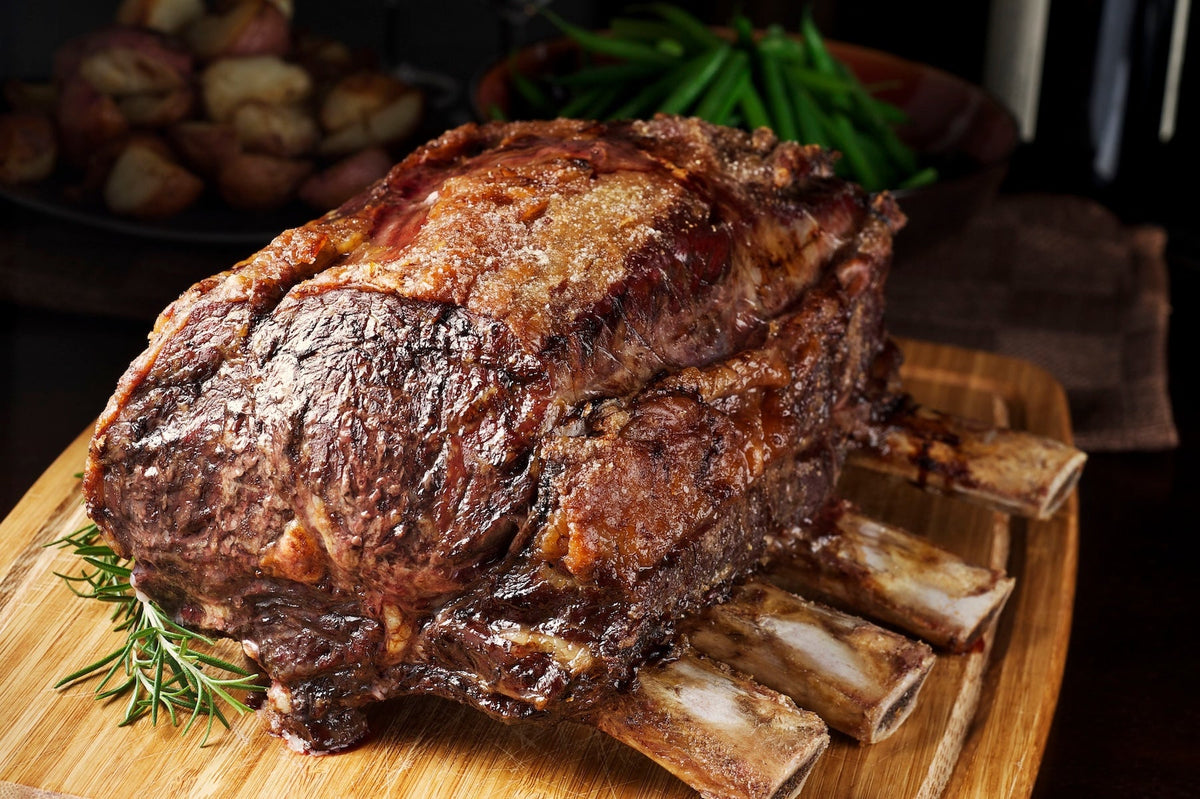
There is nothing better than a properly cooked Roast Beef, with a rich crust and a soft pink middle. As prices skyrocket, it is becoming, for most of us, an occasional treat rather than a Sunday staple. Which is why, for me, buying the best piece of meat I can afford and cooking it to perfection, is so important.

One of the best gifts I’ve been given was the book Meat by Hugh Fearnley-Whittingstall, and I have him to thank for almost all my roasting confidence. If, like previous me, you are never quite sure how your roast is going to turn out, how pink it will be in the middle or how crusty it will be on the outside, I recommend getting hold of a copy.

How I cook Roast Beef – read this first

There are three important stages to cooking perfect Roast Beef.

1. The sizzling stage where I put the joint into a very hot oven (230 °C) for around 20-30 mins, to help the meat to seize, keeping the juices in and forming a delicious crust.

2. Turn the heat down to 160 °C and cook according to the minutes per kilo below.

3. Let the meat rest for at least 15 minutes before carving.

If making your own gravy, and an onion cut in half to the pan. This will add a caramel colour and some extra flavour to the finished gravy.

What Beef should I buy?

The best you can afford from a reputable butcher would be my ideal scenario, but even a cheaper roast from a supermarket will benefit from being properly sizzled, roasted and rested.

My favourite is beef rib, on the bone, and at Christmas, if it’s the main event, this is what I’d usually go for. I also enjoy rolled rib, rolled sirloin and rump, or topside for a more economical option. There is, of course, beef fillet, but I don’t generally consider this to be in the Roast Beef genre as it’s delicate structure is better saved for Beef Wellington, or as tender steaks.

To salt or season?

I used to be afraid of putting salt onto roast beef, for fear of making the meat dry. But I’ve found that rubbing the joint all over with a very small amount of olive oil and a sprinkle of flaky salt (I use Maldon), does not appear to alter the moistness of the meat, and helps to provide a perfect crust.

Roast Beef weights and roasting times

My stress-free method to perfectly cooked meat

Check the weight of the meat and write down the times and temperatures on a scrap of paper from the table below.  Set an alarm at each stage. 

The Sizzle at 230 °C

20 mins per kilo if the meat weighs less than 2kg

30 mins per kilo if the meat weighs more than 2kg

PLUS The Roast at 160°C

Rare: 10mins per 500g (Under 2kg),  9 mins per 500g (Over 2kg)

Medium: 15 mins per 500g (Under 2kg), 12 mins per 500g (Over 2kg)

Well Done: 20 mins per 500g (Under 2kg). 18 mins per 500g (Over 2kg)

PLUS The Rest    

15 mins total (Under 2kg), 20 mins (Over 2kg)

Resting the meat

Resting the meat is one of the most important parts of the process. It ensures that all the juices are reabsorbed back into the meat, keeping it nice and juicy. I remove the meat from the oven straight away and transfer it to a wooden board, and cover it lightly with a piece of tin foil – although as long as it’s in a relatively warm place and not in a draught, you do not have to cover it.

Mary’s Posh Christmas Gravy

The Beef Stock

Making your own beef stock is pretty easy, although it will create a sort of beefy smog in your kitchen and it’s not always easy to get access to the bare bones. 

I often buy some fresh beef stock from the butcher or supermarket. You could also use a cube but I find these rather strong and salty.

If I have the time, the energy and the forethought here’s how I make my own beef stock

I get bones from the butcher in advance and roast them before covering them with cold water, bringing to a gentle boil, skimming off the scum then reducing to the lowest possible heat so that only a few little bubbles break the surface and leaving it like that on the stove, in a slow cooker or in a very low oven, for several hours. Drain and cool. Skim off the fat. Put the stock back in a big pan and fast boil until it reduces to about a third. This is your beef stock. 

Making the Gravy

When the meat has finished cooking, I tip the roasting pan into its side and skim off most of the fat. 

I don’t like gravy that tastes floury, so I add a scant half a tablespoon of plain flour to the pan and stir like mad over a low heat to make a smooth paste. Ignore any bits of onion that might be in there as these will be strained out later.

Add about half a glass of red wine to the pan and continue to stir until everything is combined and the alcohol has largely burned off. 

Slowly add around a pint of the beef stock, stirring all the time, until the gravy has is smooth and has thickened.

Sieve the gravy into a saucepan, bring to the boil, and reduce until it has the consistency of a silky gravy or a thick ‘jus’.  I sometimes whisk in a tiny knob of butter right at the end to add a bit of gloss.

If you like your gravy thicker than this, you can either add more flour at the beginning, add a tsp of cornflour mixed with cold water, bring to the boil and stir till it thickens, or of course, add some gravy granules. As with all things, it’s a question of personal preference. 


Big red wines to pair with Beef

So many fabulous choices to go with Roast Beef depending on your mood, and your budget. Here are far too many of our favourites.